

The first time our team walked into a school to deliver sexual health education to a group of Deaf young people, they were not prepared for what they would hear.
Young people were disclosing rape without knowing that is what it was. They could not name their own body parts. The concept of consent had never been explained to them. Some believed that socks and crisp packets were viable alternatives to contraception, because nobody had ever taught them otherwise.
This was not carelessness. It was a system that consistently left Deaf young people out of one of the most important conversations we have with young people.
“People were disclosing rape, but they didn’t know that was what it was.”
That visit led to three years of national research across England and Scotland. What we found was not an isolated case. It was a pattern.
35% of Deaf people received no sex education at school.
Of those who did, 65% described the information as inaccessible. Not because they were not engaged, but because the lesson had been handed to a teacher with no BSL and no materials that worked visually. Sex education assumes literacy. For many Deaf young people whose first language is British Sign Language, that assumption alone is enough to shut the door.
A joint report with BPAS found that fewer than half of Deaf young people knew the age of consent, and more than half believed it was acceptable for a partner to say: “If you don’t have sex with me, it means you don’t love me.”
“We are always looking to unlock the way forward for Deaf people,” says Helen. “Where there are barriers, we look for ways around them.”
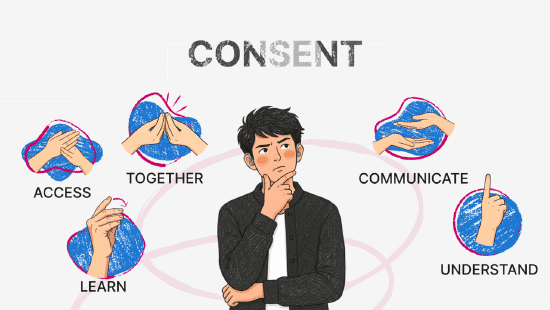
At Deafax, our approach has always been built around access, not just awareness. Within our sexual health programme, we go into schools with first-language BSL trainers. We develop visually led, culturally sensitive materials so families from all backgrounds feel comfortable allowing their children to participate. Sessions cover consent, contraception, healthy relationships, online safety and the right to say no. When we leave, the work does not stop. We upskill professionals and return when needed. Online delivery means schools nationwide can access the same quality of support. We do this because a partial conversation is not a conversation at all.
Over 40 years we have worked with schools, teachers, parents, healthcare providers and the probation service. The goal has never changed. Every Deaf young person should leave school with the language and knowledge to keep themselves safe, recognise when something is wrong, and understand their rights.
We are still the only UK organisation delivering this work in BSL, in schools, with Deaf educators. We hope others join us in closing that gap.
Forty years in, and we are just getting started. Follow along and join the conversation.