


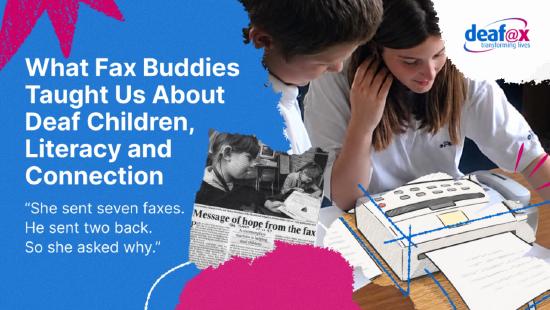
An eight-year-old girl had sent seven faxes to her Buddy.
He had sent two back.
So she picked up a pen and asked, why only two.
That kind of confidence does not come from nowhere. It comes from giving a child a real audience, someone who reads what they write and writes back. For Deaf children in 1997, that was rarer than it should have been.
More than 90% of Deaf children grow up in hearing families. Many move through a hearing school system where communication on their own terms is limited. Writing had a purpose in theory but in practice, for many Deaf children, there was no one waiting on the other end. No reply. Just words going nowhere.
Fax Buddies was built to change that.
Launched in 1997 in partnership with BT and the National Council for Educational Technology, the programme matched Deaf children across eight schools with real adult volunteers. Each child wrote to their buddy once a week by fax and their buddy wrote back.
For many of these children it was the first time a real person had written back to them directly. Not a teacher. Not a parent. Someone who was there just for them.
Over twelve weeks, the evidence built quietly. 515 faxes sent by the children. 417 replies received. Teachers began noticing things they had not seen before: longer letters, better spelling, growing confidence and greater independence. Children who had something to say, and for the first time, someone to say it to.
The programme attracted attention beyond the classroom.
Even when the Secretary of State for Education heard about it, he did not just send a letter of support. He signed up as a Fax Buddy himself.
In the next post we are going deeper into this story. The full history, the voices of the children involved and what Fax Buddies unlocked for Deafax’s work in the decades that followed.