

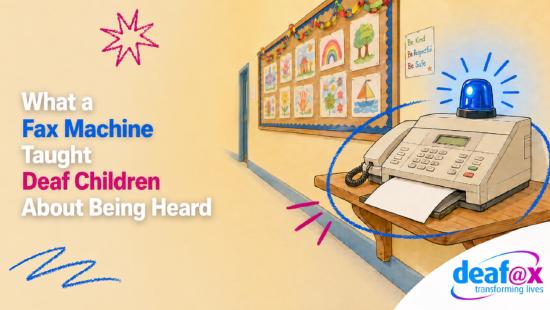
In 1997, a fax machine at Heathlands School in Hertfordshire had a strobe light attached to it. When a message arrived, the light flashed so a Deaf child could see it. One Friday, it flashed for an eight-year-old girl called Donna. She pulled the page through, read it, and wrote back.
Her adult fax buddy had sent her two messages. She had sent him seven. So she put it in writing:
“Hello John. Why you not send me a few. I want you send me a more the fax please and a lots the fax and funny you sent me is 2 I sent you is 7 fax…. Why you send me 2?”
English was not Donna’s first language. She was profoundly Deaf, writing in a language she had learned without ever absorbing it the way hearing children do. And yet: greeting, subject, evidence, argument, question. A complete piece of functional communication, written by an eight-year-old, to hold an adult accountable. Nobody had prompted her. She wrote because she had something to say and someone waiting to read it.
That is what Fax Buddies made possible. To understand why it mattered, you need to understand what it was built around.
The conversation that was never designed for you
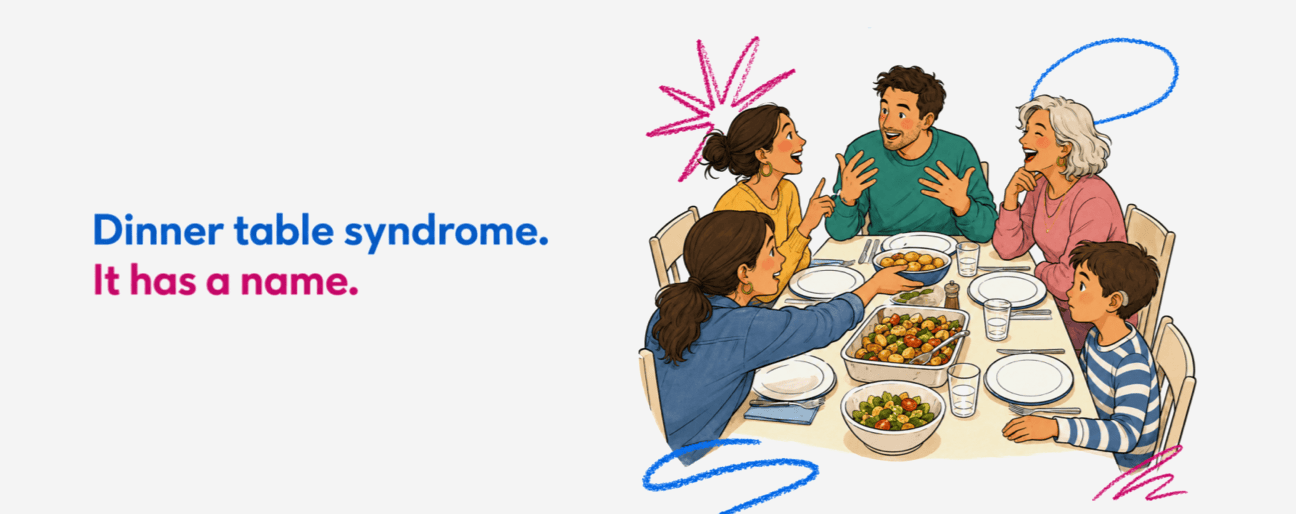
Picture a family dinner table. Conversation moves around it the way it always does: someone starts a story, someone interrupts, a joke lands, everyone laughs. For a Deaf child in a hearing household, that table is where language deprivation happens quietly, meal by meal, year by year. Researchers call it dinner table syndrome: the gap between being physically present in a conversation and actually having access to it.
A study published in PLOS One found that Deaf adults raised in hearing households were over seventeen times more likely to report rarely or never following family conversation as children. That figure is easier to understand when you consider that more than 90% of Deaf children are born into hearing families. For most of those children, the dinner table is where language was happening all around them and reaching none of them.
For many Deaf children, particularly BSL users, written English is a second language learned without the conditions that make any language feel natural. There is no overhearing it, no absorbing it passively from background chatter or a radio in the kitchen. Every sentence has to be earned. And the telephone, which became the dominant channel for everyday communication, was something many Deaf people had grown up seeing as simply not for them. Strip out the incidental, passive ways hearing children build language, and a Deaf child is left working much harder for much less.
The classroom tried to fill that gap. Children wrote sentences for marking and produced essays for teachers. The problem was not the writing itself. It was that none of it went anywhere. There was no reply, no follow-up, no real exchange. Writing for a grade teaches a child how to produce text. Writing to someone who writes back teaches them how to communicate, and those two things produce very different children.
Deafax had spent years watching this play out in school visits and workshops. Their position was straightforward: literacy as an exercise produces children who can write but do not want to. Communication as a lived experience produces children who have something to say.
As Helen Lansdown, Chief Executive of Deafax, put it: “Visual telecommunications technology is especially important to Deaf and hard of hearing children because it can empower them and provide them with incentives to read and write.”
For Deafax, the fax machine was a way of giving a Deaf child a real correspondent, a real reason to write, and a real message waiting on the other end. Fax Buddies was how they put that into practice.
Eight schools, one fax a week
Deafax launched Fax Buddies in 1997 in partnership with British Telecom and the National Council for Educational Technology. Eight schools. Deaf children aged seven to sixteen. Adult volunteers from BT, NCET, and the Department for Education and Employment, matched in groups of six to eight.
The rhythm was simple and, for the children, sacred. Faxday was Friday. Pupils composed their messages themselves and sent them without assistance, support staff stepping back unless asked. Teachers described children rushing down the corridor to watch their fax come through. Getting started was accessible by design: Deafax brought in trained staff, many of them Deaf and BSL-fluent, who walked the children through how the machines worked, from feeding a page through to programming the school’s own number in. Children who could word-process typed their messages, picking up IT skills alongside everything else.
Among the volunteer buddies was the Rt. Hon. David Blunkett MP, the then Secretary of State for Education and Employment. Blunkett was born blind and was at that time the first blind person to sit in a British Cabinet. He knew from his own life what it meant to grow up in a world not built around how you experience it. He understood precisely what the fax machine was doing. For a Deaf child, it meant a message in writing, at your own pace, with no lip-reading and no catching up. For a blind minister, it meant correspondence that could be read aloud, the same as any other letter. Two very different lives. One piece of equipment removing the same barrier for both of them.
His involvement carried the argument the whole programme was making. Design something around access and it does not just serve the person you had in mind. It opens the door for everyone standing behind them
What the faxes showed
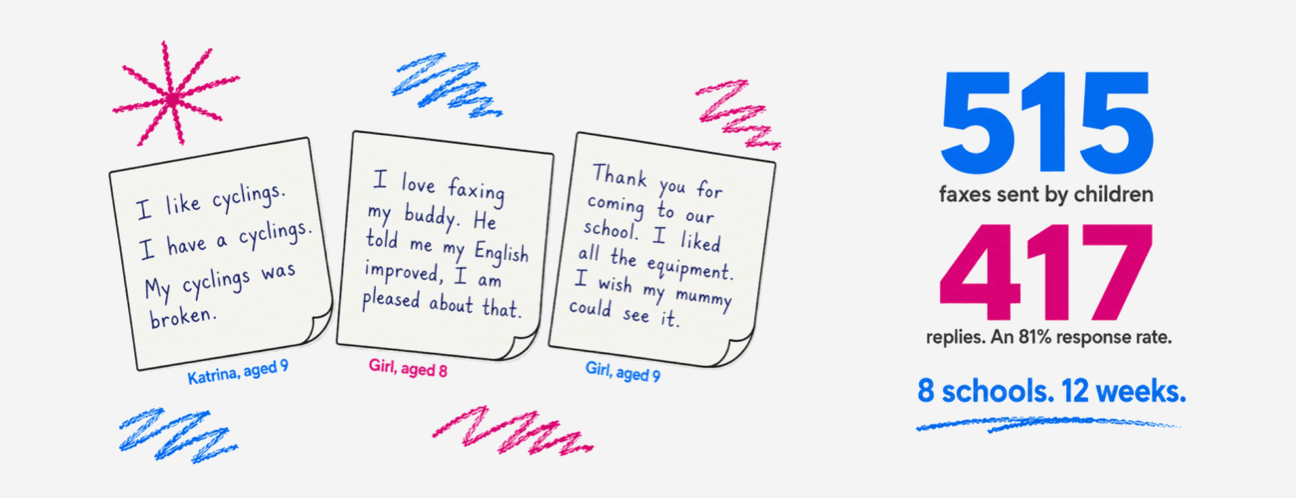
Over twelve weeks, the children sent 515 faxes. 417 replies came back, an 81% response rate from volunteers fitting a weekly message around their working lives, in some cases writing to a child they would never meet in person.
The picture across all eight schools was consistent: clearer handwriting, longer letters, wider vocabulary, more confidence, and the thing teachers kept returning to above everything else: motivation. Children who had managed two sentences for years began filling pages. The shift did not come from the curriculum. It came from the fact that someone was waiting to read what they wrote.
Donna moved through two buddies during the twelve weeks. When the second slowed down, she did not wait for a teacher to notice. She tracked every fax she had sent and every one she had received, and wrote to tell him the numbers did not match. Her English was imperfect in exactly the way an eight-year-old’s English is imperfect. The structure of her argument was not.
Katrina, aged nine, came across the word “cycling” in a fax from her buddy and asked her teacher what it meant. Then she used it in her reply: “I like cyclings. I have a cyclings. My cyclings was broken.” She had not learned it from a worksheet. She had learned it because someone she liked had used it and she wanted to know what he meant. That is how language actually works.
In Scotland, a five-year-old boy attending a workshop sent a test fax to the school office just to watch it arrive. His mother, at the side of the room, quietly decided she would look into getting one for home. The reach of the programme extended well beyond the children in it.
Why it worked
Research that has emerged since helps explain what Deafax was observing in those eight schools.
Many Deaf children have an incomplete map of English sounds, which means the phonics-based approaches most classrooms still rely on give them very little to hold onto. What works instead is learning rooted in real meaning: a real person, a real exchange, something worth responding to.
The fax delivered that. There were no sounds to decode, no lip-reading, none of the fatigue that builds up across a Deaf child’s school day from working twice as hard to access the same lesson as everyone else. Just a message, in writing, from someone who mattered, with time to read it and time to reply.
For children who had spent their school lives writing for an audience that never wrote back, the exchange was the point. The research caught up with what those eight schools had already found.
From a strobe light to a phone in your pocket
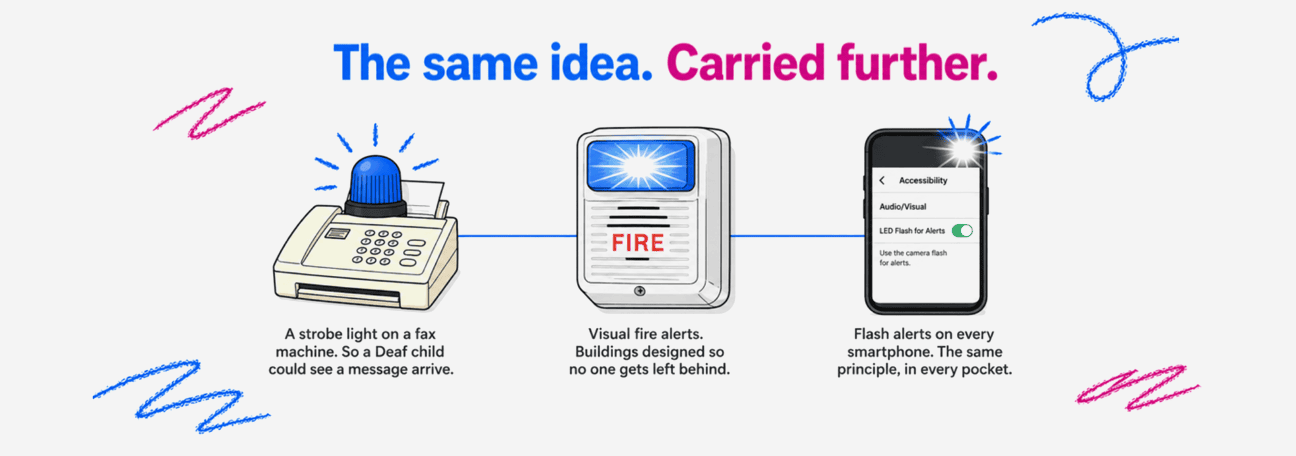
The strobe light on that fax machine had one job: make a silent arrival visible. That same principle is now embedded in the devices everyone carries.
Flash alerts and screen notifications are standard accessibility settings on every smartphone. The logic runs further than that, into how buildings are designed, with fire and emergency systems built around visual signals because a Deaf person needs to know there is an emergency exactly as fast as everyone else does.
What began in one school corridor is now part of how public infrastructure works.
The telephone had long been inaccessible to many Deaf people. The minicom, the slow text terminal that sat alongside the fax in 1990s communications kits, was the workaround available at the time. What replaced it is a different thing entirely. Ofcom’s 2025 review of 999 BSL, the UK’s emergency video relay service, found it had handled around 20,000 calls in a single year and estimated it likely saves at least two lives annually. A Deaf person calling 999 today signs, in BSL, to a real interpreter, in real time. The gap the minicom was patching over has been rebuilt from the ground up.
Deafax has carried the same question through all of it: where is access missing, and what does it take to build it in properly? That question led to Signly, an app that places BSL video directly onto printed and digital materials, so a Deaf BSL user can point their phone at a page and see it signed. Co-developed with the Roald Dahl Museum, it won a Jodi Award and a Financial Innovation Award in 2017 and has since been taken up by Lloyds Banking Group, Network Rail, and others.
Thirty years of consistent commitment to a single idea, held across changing technology, changing organisations, and a very different world.
What Donna’s fax is still doing
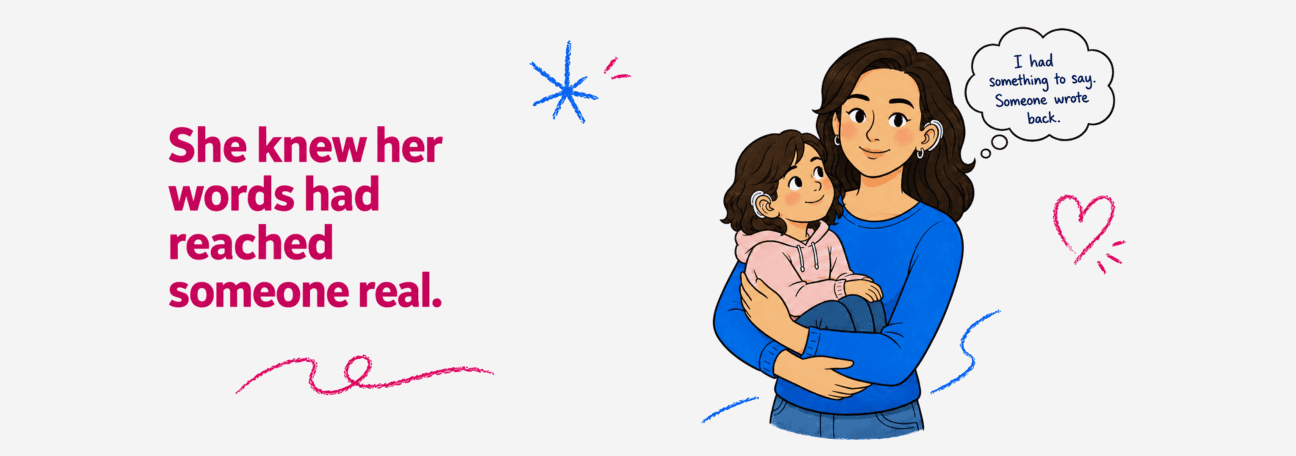
Donna is in her mid-thirties now. At eight years old, in a language that was not her first, using a machine she had only just learned, she tracked every fax she had sent and every one she had received, and wrote to tell her buddy the numbers did not match. She knew her words had reached someone real, and she expected a real response.
The conditions Deafax built for her in 1997 exist in a different form today. The strobe light is a notification on a phone. The relay service is a legal right. The app is on the museum wall. Each of those things is the same idea, carried further: that a Deaf person’s access to the world around them should not depend on luck, goodwill, or a teacher who happened to attach a light to a machine.
Fax Buddies was where that work took root. What grew from it is still growing.