

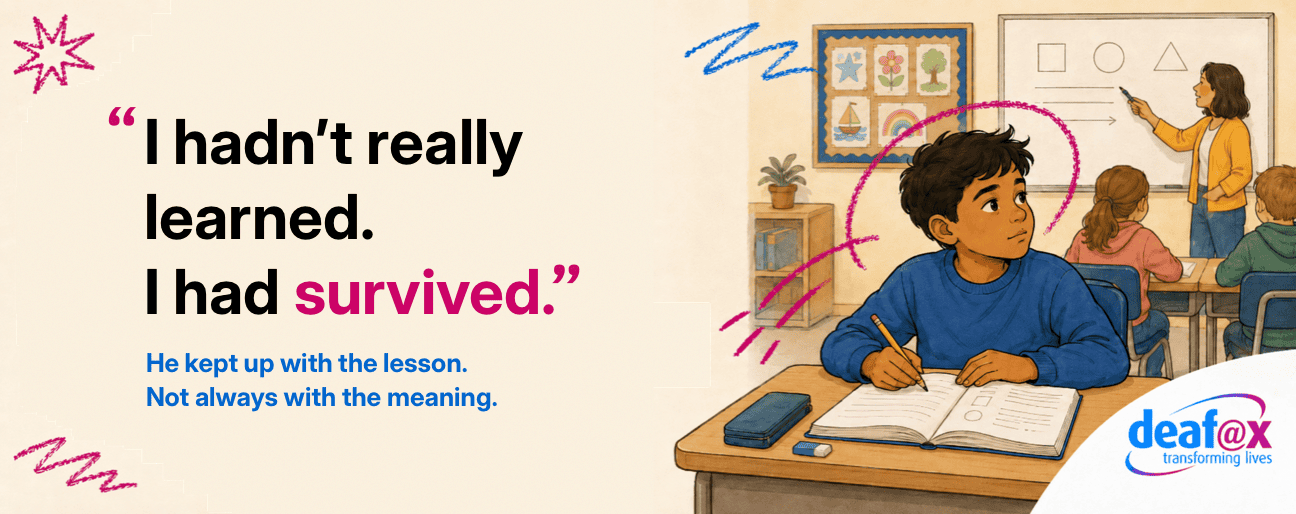
“I hadn’t really learned, I had survived.”
Andrew Mootoo said that about his early education in Spain. Not as a complaint. As a statement of fact, delivered with the clarity of someone who has spent a long time understanding exactly what happened to him, and why.
Andrew was eighteen months old when meningitis left him profoundly Deaf. His mother responded to that moment with a determination that would shape everything that followed. She taught him to lipread, spent years nurturing his speech and communication, and found a specialist Deaf school in Spain where he would remain until he was seventeen.
More than any of that, she gave him the confidence to move through the world on his own terms. Travelling by bus, exploring his surroundings, trusting his own abilities.
She understood that independence wasn’t just a practical skill. It was something a person had to believe they were capable of before they could live it.
The school itself, though, could only take him so far. Spain had no officially recognised sign language at the time. What existed was a regional pidgin system, unacknowledged by the government, varying from place to place.
Most of his teachers were hearing, working across a mix of oral methods and basic signing, and it was in those classrooms that Andrew picked up Spanish and Spanish Sign Language. He built friendships there that have lasted decades. The education he received gave him a foundation, even if the system around it couldn’t give him full access.
With the foundations his mother had laid alongside it, Andrew found his own way through.
He copied notes from the board. He reproduced pages from textbooks. He kept up with the surface of what was being taught without being able to reach the meaning underneath it.
“I could reproduce the content, but when it came to exams I was out of my depth.”
This wasn’t a failure of one school or one teacher. It was the result of a policy that had shaped Deaf education for over a century.
After the 1880 Milan Conference, signing was pushed out of Deaf classrooms across Europe and the UK alike. Deaf children were taught through lip-reading and speech. Those who signed were punished. In England, many schools resisted signing altogether and pushed to integrate Deaf children into mainstream settings where the support to access learning was rarely there. BSL wasn’t formally recognised by the UK government until 2003, and the idea of Deafness as a culture and identity in its own right was still gaining ground.
The failures Andrew experienced were part of something far wider than any one country’s system.
Wherever he had grown up, the language through which he made sense of things wasn’t recognised as a language by any government, wasn’t protected, and wasn’t required in any classroom.
The consequences of that are still visible.
The average reading age of a sixteen-year-old Deaf school leaver in the UK sits at just eight to nine years, a figure that has not improved in over fifty years. That is not a measure of what Deaf young people are capable of. It is the measure of what happens when children spend years being taught in a language that was never fully theirs to begin with.
Andrew wasn’t failing. The system around him was. And he already knew the difference.
What it actually takes
At seventeen, Andrew moved to England. He had grown restless in Spain, unchallenged and increasingly difficult to manage because the system around him had nothing more to offer.
His mother recognised it before anyone else did, and she researched schools in England with the same determination she had brought to everything else. She found Exeter Academy for the Deaf, a school that typically stopped admissions at sixteen. His father negotiated a place. A social worker supported the application. An education authority meeting was convened with funding on the table. At the end of it, Andrew was offered a one-year place with one-to-one support built in. Sometimes he was withdrawn from class for extra help.
“It made all the difference”
The same person who had spent years in a system that couldn’t reach him arrived somewhere that could, and the outcome changed. Not because Andrew changed. Because the conditions did.
That kind of negotiation is not exceptional. It is what Deaf children and their families are regularly asked to do. By the time Deaf pupils complete secondary school, they achieve an entire GCSE grade less than their hearing peers on average, with fewer than four in ten securing a grade five or above in English and Maths. That gap doesn’t appear at sixteen. It starts building from the first year of primary school, where 65% of Deaf children finish without reaching the expected level of development, compared to 34% of their hearing peers.
Andrew’s parents fought their way around a system producing those outcomes. None of it should have been necessary. It was necessary because nothing in the system was designed to make it otherwise.
Even at Exeter, access wasn’t complete. Andrew studied Graphic Design, Literacy, Maths, and Accounts. He loved a Spanish language course he took alongside those subjects, something that connected him to his family roots. But the tutor wasn’t a native speaker and the course relied on audio recordings he couldn’t hear.
“I missed chunks of material, but I kept going.”
That quality runs through everything Andrew has done since. The system kept presenting gaps. He kept finding a way through them.
Before Andrew and Deafax met
What Andrew did between Exeter and Deafax isn’t a footnote. It’s the chapter that explains why, when Deafax did find him, nothing about it felt accidental.
He joined Common Ground, a touring theatre and dance company, and performed across London and the UK alongside Deaf actor David Brower, who appeared in Four Weddings and a Funeral. For Andrew, performing in a space where visual communication was the point rather than a workaround was something he hadn’t experienced in a formal setting before.
At the same time, he was making his own short films in Oxford, developing a visual language for storytelling that was entirely his own. That body of work, built without institutional support or a clear pathway at the end of it, earned him a place on the Theatre Arts, Education and Deaf Studies Diploma at the University of Reading.
That’s where he met Ken Carter, founder of Deafax, an organisation built around the idea that visual communication and technology could transform what was possible for Deaf learners.
“I remember meeting Ken and immediately appreciating his highly visual communication style and his mission to widen access for Deaf learners.”
Ken recognised in Andrew something that couldn’t be taught: someone who had lived the experience of being failed by inaccessible resources and had spent years developing a visual language in response to it. Andrew was then offered a role designing visual materials for Deafax’s projects.
Two people who had spent years arriving at the same place, that Deaf learners deserved resources built around how they actually communicate, finally working in the same direction.
The philosophy that came from memory
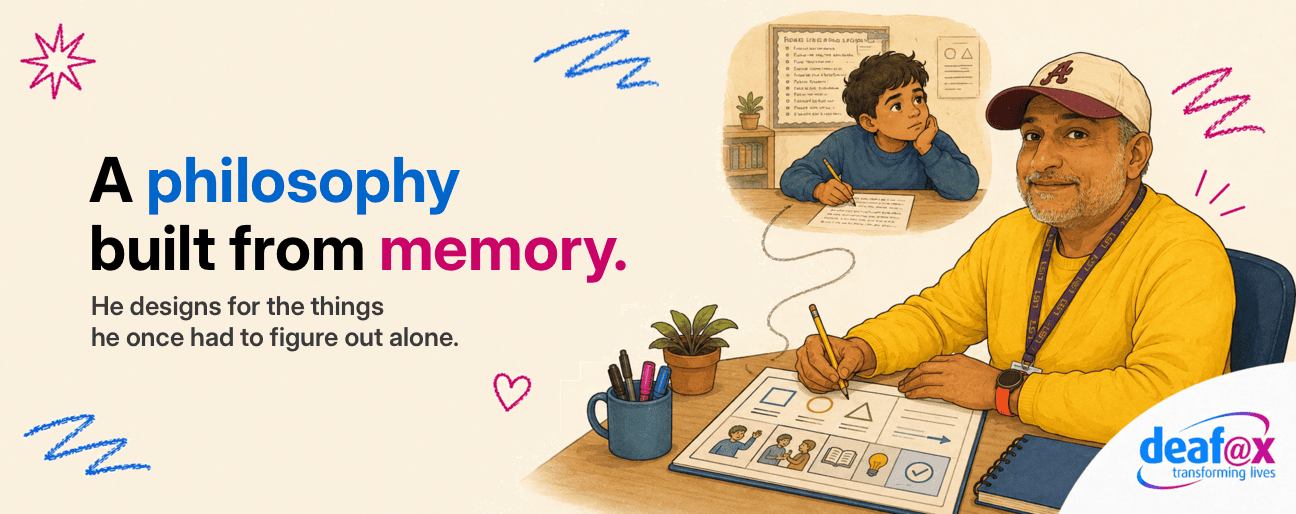
Andrew didn’t arrive at Deafax with a theory.
He arrived with something harder to come by: a clear, personal understanding of what it felt like to sit in front of a resource not built for him. When he started work on Fax Buddies, a BBC Children in Need funded project connecting 150 Deaf children through fax machines, he already knew what was wrong with the existing materials before he’d finished reading them.
“The fax machine manuals were far too wordy, so I re-designed them with images and a more visual logic. Suddenly, instructions made sense.”
The approach Andrew developed was 70% visual, 30% English. It sounds like a design choice. It was a practical one.
BSL has its own grammar and structure, entirely separate from written English. For a child whose primary language is BSL, reading a dense English document means working through a completely different grammatical system at the same time as trying to take in what is being said. There isn’t much space left for learning. For many of the children on Fax Buddies, English was a second or third language. Andrew’s redesign didn’t just make the manuals easier to follow. It gave those children the mental space to actually learn from them.
“I saw that Deaf children needed resources that were far more pictorial, clear, engaging, and Deaf-friendly.”
What he built was practical. It came from knowing what it felt like when the tools available weren’t made for you, and from finally being in a position to do something about it.
Fax Buddies also taught him things beyond design.
“I valued the BBC Children in Need project. It taught me planning, budgeting, working to targets, and measuring impact.”
What he developed through that project stayed with him. It shaped how he worked for years afterwards.
A cow hat in New Zealand
Deafax was using technology to do something few organisations were attempting at the time: connect Deaf children across borders, in their own language, with nothing lost between them.
Videoconferencing in those days meant BT, ISDN lines, and equipment that took up entire suitcases. No Zoom, no Teams, no Wi-Fi as standard. But even with all of that, what it made possible was significant.
“I could connect live with Deaf children as far away as New Zealand, and they knew my sign name: the cow sign, a play on my surname of Mootoo.”
Helen Lansdown, Chief Executive of Deafax and co-founder of Signly, a platform that brings sign language directly onto websites, remembers the photographs from those sessions. Andrew wore a cow hat. Children in New Zealand recognised him from it the moment he appeared on screen, before they’d ever been in the same room as him.
That wasn’t a small thing. It meant Andrew’s work, his visual approach, his way of communicating with Deaf children, had reached the other side of the world. Children there knew who he was, responded to him, and engaged with him as someone who communicated in a way that made sense to them. Deafax had built the platform. Andrew had become the person children across the world connected with through it.
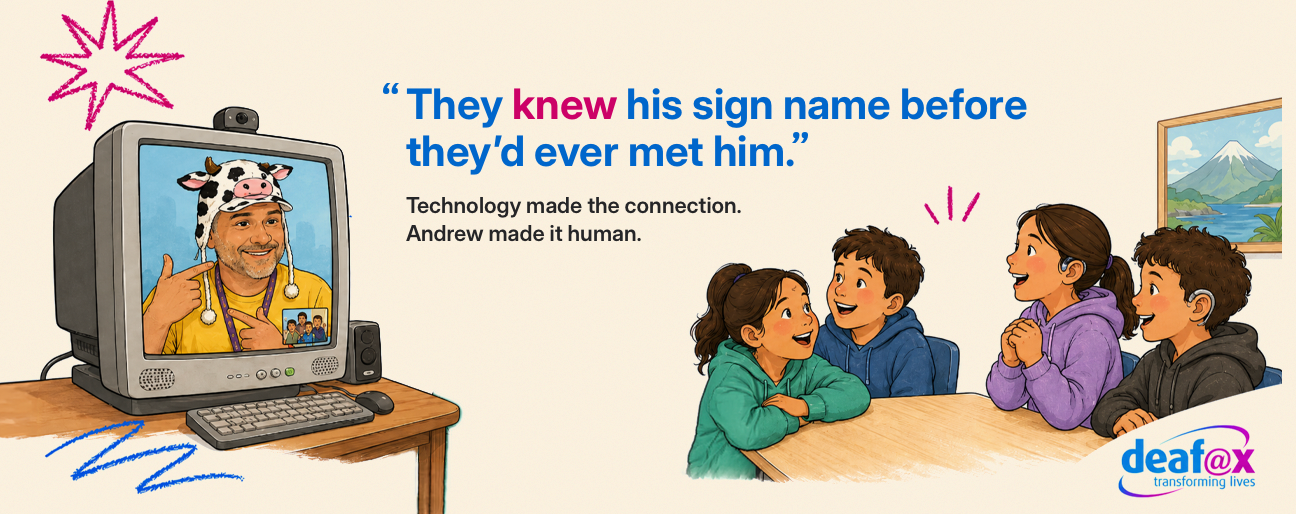
“Faxing felt like magic. Messages arriving from the other side of the world, with a hands-on thrill that drew children in and showed them the value of connecting and communicating.”
Through Deafchild International, Andrew took that work further. He travelled to Barbados, working directly with Deaf teachers and pupils, introducing them to interactive Smart Boards and showing them what visual, technology-led learning could look like in their own setting.
He wasn’t there to observe. He was there to pass something on.
“British Deaf children often have more advanced technologies and opportunities than peers in places like Barbados.”
The gap between what Deaf children in different countries can access is real. Back home, there was also a project with mobile provider 3G, giving phones to a research group of Deaf users at a time when the costs were seen as too high. The Deaf community’s relationship with technology has never been passive.
“Over time, as texting and mobile communication spread, the Deaf grapevine did its work. Confidence grew, and phones became a positive, affordable tool for connection.”
Andrew understood that willingness to go first better than most. After moving to England, staying in touch with his mother in Spain had meant depending on his hearing brother to interpret their telephone conversations, a reminder every time of how much the technology of the day still couldn’t do.
Every advance in communication technology since, from texting to video calls, closed a gap he had felt personally long before he started closing them professionally for others.
Still designing. Still building.
Andrew hasn’t stopped. Decades after he first sat in a classroom copying notes from a board, he is still finding new ways to communicate visually and still creating things that work for the people they’re made for. He designs with digital tools that would have been unimaginable when he started out. He joins an international signing group on Zoom, connecting across borders in the same way he helped Deaf children do when New Zealand felt like the other side of the world.
“Technology has widened my world in ways I couldn’t have imagined when I was young.”
Living with multiple sclerosis means Andrew navigates the NHS regularly. He knows firsthand what it costs when communication access isn’t there. Nearly two thirds of Deaf patients miss at least half of the vital information shared during NHS appointments. More than half are forced to rely on friends or family to interpret, giving up the medical privacy that hearing patients take for granted.
Those aren’t abstract figures. They describe his world.
Which is why, when the conversation turned to Visual Hospital, a Deafax platform providing BSL-first resources to help Deaf patients understand and prepare for NHS appointments, Andrew didn’t wait to be asked.
He brought it up himself.
“That’s exactly the kind of practical innovation we need. If we set a new standard for visual, inclusive design in healthcare, we won’t just fix isolated problems. We’ll change the culture of care.”
Deafax has already secured funding to expand Visual Hospital further. More settings, more patients, more moments where a Deaf person walks into a healthcare appointment knowing exactly what to expect. Andrew wants to be part of building every one of them.
Helen describes him as always available: ready to feed back, to guide, to make sure what Deafax builds continues to reflect the people it exists to serve. That availability isn’t incidental. It’s the same instinct that has driven everything Andrew has done since he first understood the difference between surviving a system and actually being reached by one.
Access doesn’t arrive. It gets built.
A Deaf child in Spain survived an education system that couldn’t reach him. A mother found the schools, laid the foundations, and gave him the belief that his deafness would never define what was possible. A father negotiated, a social worker supported, and a funding meeting was convened so that one student could access what every student is supposed to be entitled to.
He took what the system had failed to give him and built a career out of making sure Deaf children didn’t have to face the same gaps. The resources he designed, the programmes he shaped, the children he connected across continents: all of it came from the same place. Knowing exactly what it felt like to be in a room where nothing was made for you, and deciding to change that.
He’s still designing. He’s still watching what gets built. He’s still making himself available to shape what comes next.
In July 2009, Andrew returned to Spain with his fiancée, Helena, for a wedding his mother organised and hosted. The woman who had found the schools, taught him to lipread, and pushed him towards a life she believed he was capable of, finally got to see what all of it had led to.
Her faith in Andrew became his own,
“Stay positive and look for solutions.”
Andrew has lived that, shaped by years of watching his mother find a way through every barrier placed in front of her son. He inherited that mindset, and then he built a career from it. The work he did at Deafax, and the work Deafax continues to do, is the evidence of what that looks like in practice.
Access doesn’t arrive. It gets built, one resource, one project, one person at a time.